Every region of India has its own way of painting and decorating, often kept alive by one community or one family for generations. Here is a short introduction to 16 of them: where each comes from, its story, how to recognise it, and how it is made.
Pictures marked "Sample image" come from museum collections and Wikimedia Commons, used under public-domain or open licences. They are shown only to help you recognise each art form; they are not KalaSutra pieces and are not for sale. Pictures without that mark are handmade pieces by KalaSutra artists.
Court painting of the Mughal emperors and the Himalayan hill kingdoms, and Buddhist scroll painting of the mountains.
Delhi, Agra and Lahore courts
Mughal miniature
16th to 19th century, Mughal royal workshops
Sample image Jahangir visiting the ascetic Jadrup, attributed to Govardhan, about 1616 to 1620. Musée Guimet, Paris, Public domain, via Wikimedia Commons.
Mughal painting began when Emperor Humayun brought the Persian masters Mir Sayyid Ali and Abd al-Samad to his court. Under Akbar, a large royal workshop of Persian and Indian artists produced illustrated books such as the Hamzanama. Under Jahangir it became famous for lifelike portraits and studies of birds, animals and flowers, and under Shah Jahan for its polish and splendour.
What to look for
Faces shown in profile, real portraits of real people, court scenes, hunts and gardens, very fine detail, and richly decorated borders.
How it is made
Handmade paper (wasli), mineral and plant colours, real gold, and very fine brushes made from squirrel hair. The painting is burnished with a smooth stone to give it a soft shine.
Himachal Pradesh
Kangra and Pahari painting
18th and 19th century, the hill kingdoms
Sample image The Gods Sing and Dance for Shiva and Parvati, attributed to Khushala, late 18th century. Google Art Project, Public domain, via Wikimedia Commons.
Pahari means 'of the hills'. Small Rajput kingdoms in the Himalayan foothills, such as Basohli, Guler, Chamba and Kangra, each had their own painters. The Kangra style grew out of the Guler school, through the family of the painter Pandit Seu and his sons Manaku and Nainsukh, and flowered under Raja Sansar Chand of Kangra, who ruled from 1775 to 1823.
What to look for
Gentle, flowing lines, cool greens and blues, rolling hills, rivers and flowering trees. Radha and Krishna, the Gita Govinda and the Bhagavata Purana are favourite themes, painted with great tenderness.
How it is made
Handmade paper, natural mineral and plant colours, gold and silver, and fine brushes, much like Mughal practice.
Ladakh, Sikkim and Himachal Pradesh
Thangka
Buddhist tradition, many centuries old
Sample image A thangka of Buddha Vairocana. Google Art Project, Public domain, via Wikimedia Commons.
Thangkas are Buddhist scroll paintings made for worship and meditation in the monasteries of the Himalayas. They show the Buddha, deities, mandalas and the wheel of life, and follow strict rules of proportion handed down from teacher to student.
What to look for
A central figure in exact proportion, surrounded by smaller figures, clouds and flames, with deep reds, blues and greens and fine gold line work. The painting is mounted in a silk border so it can be rolled up.
How it is made
Cotton cloth primed with a chalk and glue ground, mineral colours, gold, and a silk mount.
West India
Royal miniatures, temple hangings and story scrolls from Rajasthan, and the folk and tribal art of Maharashtra and Gujarat.
Rajasthan
Rajasthani miniature
16th to 19th century, the Rajput courts
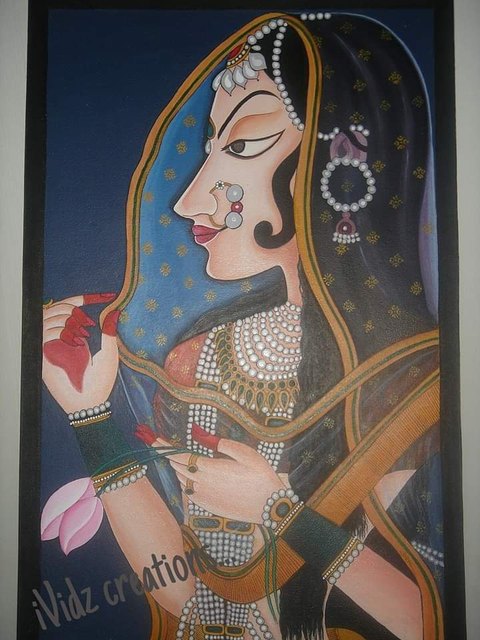
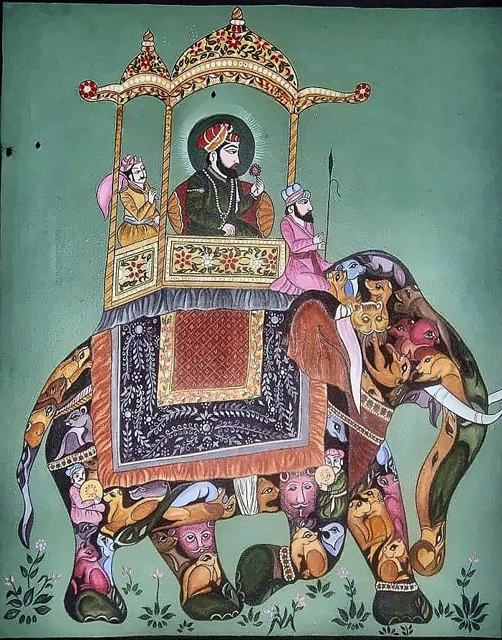
Bani Thani, after the Kishangarh originalRoyal Elephant Procession
Rajasthani miniatures by Vidya Bhandari for KalaSutra: handmade replicas of original paintings from the palaces of Rajasthan, in acrylic and watercolour on mount board and canvas board.
Each Rajput court in Rajasthan built its own school of painting: Mewar (Udaipur), Bundi and Kota, Kishangarh, Marwar (Jodhpur), Jaipur and Bikaner. The Kishangarh painter Nihal Chand's 'Bani Thani', with her long eyes and graceful profile, is one of the best known Indian paintings. Krishna, the Ragamala (paintings of musical modes), the seasons and court life are common subjects.
What to look for
Bold, bright colours, flat areas of red, yellow and green, stylised figures with large eyes, palaces, lotus ponds, and patterned borders.
How it is made
Handmade paper, mineral and plant colours, gold, and very fine brushes. Many artists still grind their own colours.
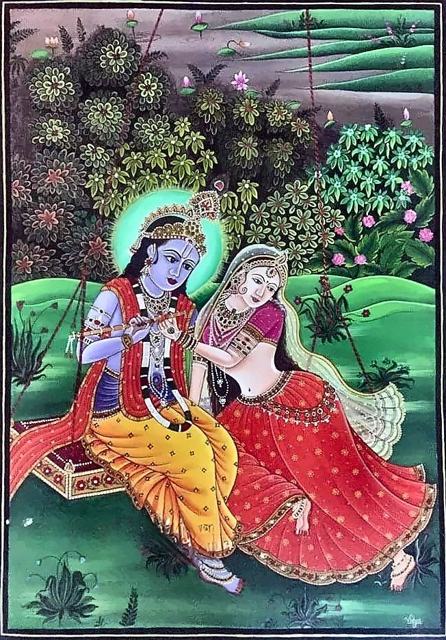
Radha Krishna on the Swing, a Pichwai painting by Vidya Bhandari for KalaSutraSample image Pichwai for the Festival of Cows. The Metropolitan Museum of Art, CC0, via Wikimedia Commons.
Pichwai paintings are large cloth hangings made to hang behind the image of Shrinathji, the child form of Krishna, at the temple in Nathdwara. The name comes from 'pichh' (back) and 'wai' (hanging). The hangings change with the festivals and seasons of the Pushtimarg tradition, such as Sharad Purnima and Annakut.
What to look for
Shrinathji at the centre, cows, gopis, lotus ponds and flowering trees, rich colours on dark grounds, and a great deal of gold.
How it is made
Cotton cloth, mineral and plant colours, and gold and silver. Large pieces can take many months.
Sample image Part of a phad of Pabuji at the Tropenmuseum, Amsterdam. Photo: MicheleLovesArt, CC BY-SA 2.0, via Wikimedia Commons.
A phad is a long painted scroll that tells the story of a folk hero-god, most often Pabuji or Devnarayan. Travelling priest-singers called bhopas unroll it at night and sing the story in front of it, lighting each scene with a lamp. The Joshi family of Shahpura and Bhilwara have painted phads for generations.
What to look for
Many scenes on one long cloth, bold yellow, red and green, figures shown side-on, and the hero drawn largest, at the centre.
How it is made
Hand-woven cloth stiffened with starch, and colours made from minerals and plants. A full scroll can run several metres.
Maharashtra
Warli
Tribal tradition, centuries old
Warli art belongs to the Warli community of the Palghar and Thane districts of Maharashtra, close to KalaSutra's own home state. Women traditionally painted it on the mud walls of their homes for weddings and harvests. The artist Jivya Soma Mashe took it onto paper and canvas from the 1970s and made it known around the world.
What to look for
Simple white figures made of circles, triangles and lines on an earthy red or brown ground. Village life, farming, and the circular tarpa dance are common scenes.
How it is made
Traditionally white rice paste on a wall of mud and cow dung, applied with a chewed bamboo stick. Today also on paper, cloth and canvas.
Kutch, Gujarat
Lippan (mud and mirror work)
Traditional craft of the Kutch desert
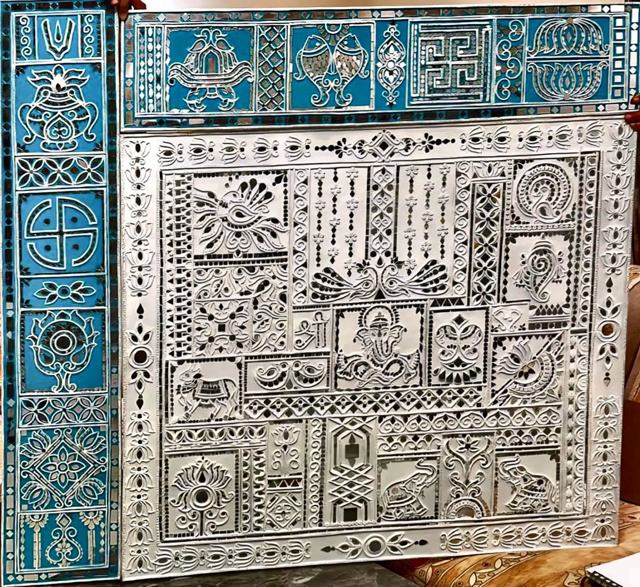
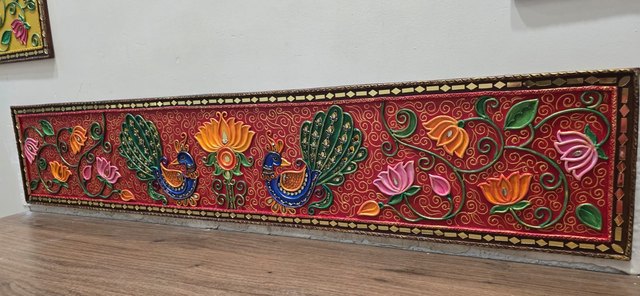
Auspicious Symbols PanelPeacock and Lotus Panel
Lippan work by Vidya Bhandari for KalaSutra
Lippan is the mud-relief and mirror work that the Rabari, Mutwa and Meghwal communities of Kutch made on the walls of their round mud houses, called bhungas. The small mirrors catch the light of a single lamp and fill the room with sparkle. Today it is made on boards as wall art, and it is one of Vidya's own specialities.
What to look for
Raised patterns of white clay, peacocks, camels and geometric motifs, with small round, diamond and triangle mirrors set into them.
How it is made
Traditionally clay mixed with camel or donkey dung, and mirror pieces called abhla. Today, clay on wood or board, mirrors and paint.
Pithora paintings are made by the Rathwa and Bhil communities around Chhota Udaipur in Gujarat and nearby Madhya Pradesh. A family has a Pithora painted on the wall of its home as an offering to the god Baba Pithora, to give thanks or ask for a blessing, and its painting is a ceremony with music and prayer.
What to look for
Rows of colourful horses with riders, inside a large frame, with animals, people, the sun and the moon around them.
How it is made
Traditionally natural colours mixed with milk and liquor on a freshly plastered wall. Today also on paper and canvas.
Central India
The dotted, joyful tribal painting of the forests of Madhya Pradesh.
Madhya Pradesh
Gond
Tribal tradition, made famous from the 1980s
Gond art grows from the wall and floor paintings of the Gond people of central India, especially the Pardhan Gond of Patangarh village in Mandla district. In the early 1980s the young artist Jangarh Singh Shyam was invited to Bharat Bhavan in Bhopal, where he began painting on paper and canvas. Artists such as Bhajju Shyam and Durga Bai Vyam have since taken it around the world.
What to look for
Trees, birds, animals and stories from Gond myth, with every shape filled with fine dots, dashes and lines. Bright, joyful colours.
How it is made
Once natural colours from earth, charcoal, plants and cow dung on walls. Today mostly acrylic or poster colour on paper and canvas.
East India
Women's wall painting from Bihar, and temple painting from Odisha.
Bihar
Madhubani (Mithila)
Centuries-old tradition of the women of Mithila
Sample image A Madhubani painting with the fish motif, by Bhuvana Meenakshi. Bhuvana Meenakshi, CC BY-SA 3.0, via Wikimedia Commons.
Madhubani painting comes from the Mithila region of Bihar and Nepal. For generations women painted it on the walls and floors of their homes for weddings and festivals, especially the kohbar, the room of the newly married couple. The British officer William Archer saw these wall paintings after the 1934 Bihar earthquake, and in the 1960s women began painting on paper. Artists such as Sita Devi, Ganga Devi and Mahasundari Devi became famous for it.
What to look for
Gods and goddesses, fish, peacocks, the sun and moon, double outlines, borders of flowers and patterns, and almost no empty space. Bharni (filled colour) and kachni (fine line) are two well known styles.
How it is made
Natural colours from lampblack, turmeric, indigo, flowers and leaves, applied with twigs, fingers, bamboo nibs or matchsticks. Today mostly on handmade paper and cloth.
Patta means cloth and chitra means picture. Pattachitra is closely tied to the Jagannath temple in Puri, and the village of Raghurajpur nearby is still home to many painter families, called chitrakars. Stories of Jagannath, Krishna and the Ramayana are painted with great care, inside ornate borders.
What to look for
Strong outlines, rich red, yellow, white and black, figures with large eyes, dense floral borders, and every space decorated.
How it is made
Cotton cloth coated with chalk and tamarind-seed gum, and colours from natural sources such as conch shell (white), lampblack and red and yellow stones. Palm-leaf pattachitra is etched with a needle.
South India
Gilded temple icons, painted temple walls and hand-drawn textiles.
Tamil Nadu
Tanjore (Thanjavur) painting
17th to 19th century, Thanjavur
Sample image A Thanjavur painting, with gold work on a deep blue ground. Photo: Klien rai, CC BY-SA 4.0, via Wikimedia Commons.
Tanjore painting flourished in Thanjavur under the Maratha rulers of the region, with painters from the Raju and Naidu communities. Made for prayer rooms and temples, it most often shows Krishna (especially as a child), Lakshmi, Saraswati or other deities, glowing with gold.
What to look for
A large central deity with a round face, raised and gilded jewellery and arches, glass beads or stones, and rich red, green and blue.
How it is made
Cloth pasted on a wooden board, a raised paste of chalk and gum for relief, thin gold foil, glass and semi-precious stones, and paint.
Karnataka
Mysore painting
Grew under the Wodeyar rulers of Mysore
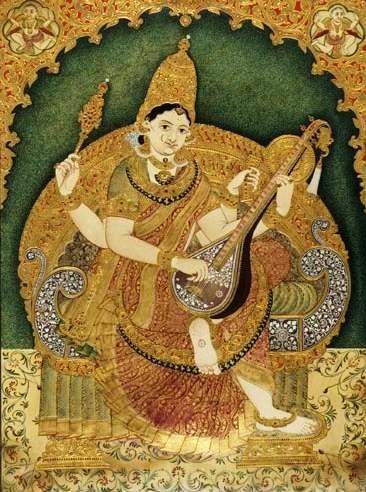
Sample image A Mysore painting of Saraswati by Durgada Krishnappa. National Gallery of Modern Art, New Delhi, Public domain, via Wikimedia Commons.
Mysore painting is a cousin of Tanjore painting that grew in the court of the Wodeyar kings, especially Krishnaraja Wodeyar III in the 19th century. It shows Hindu gods and stories from the epics.
What to look for
Finer and quieter than Tanjore work, with delicate gold, soft colours and lots of fine detail.
How it is made
Paper or cloth on a board, a thin raised gesso layer, gold leaf, and natural or watercolour paint.
Kerala
Kerala mural
Temple and palace walls, mostly 15th to 19th century
Kerala murals cover the walls of temples and palaces such as Mattancherry Palace in Kochi and the Vadakkunnathan temple in Thrissur. They follow old texts on proportion and show gods, goddesses and scenes from the epics.
What to look for
Large, rounded, richly ornamented figures, strong outlines, and a warm palette of five main colours (panchavarna): red ochre, yellow ochre, green, white and black.
How it is made
Traditionally colours from minerals and plants on lime-plastered walls. Today also on canvas.
Andhra Pradesh
Kalamkari
Centuries-old textile tradition
Sample image A kalamkari rumal (cloth), hand-painted and dyed cotton. The Metropolitan Museum of Art, CC0, via Wikimedia Commons.
Kalam means pen and kari means craftsmanship. In Srikalahasti, artists draw freehand with a bamboo pen, often painting temple hangings with scenes from the Ramayana and Mahabharata. In Machilipatnam and Pedana, the designs are block-printed, with Persian-style flowers and creepers.
What to look for
Earthy reds, indigo, mustard and black, fine outlines, and long story panels or flowing floral patterns.
How it is made
Cotton cloth treated with myrobalan and milk, alum mordant, and natural dyes such as indigo and madder. The cloth is washed and dried many times, so one piece takes weeks.
Bring a living tradition home
KalaSutra works with artists who keep these traditions alive. You can browse Rajasthani miniatures and Lippan work today, and ask us to commission a piece in another art form.
Some art forms on this page are living traditions practised by artists today, so we show their work only with permission. We will add pictures as artists in each form join us.